
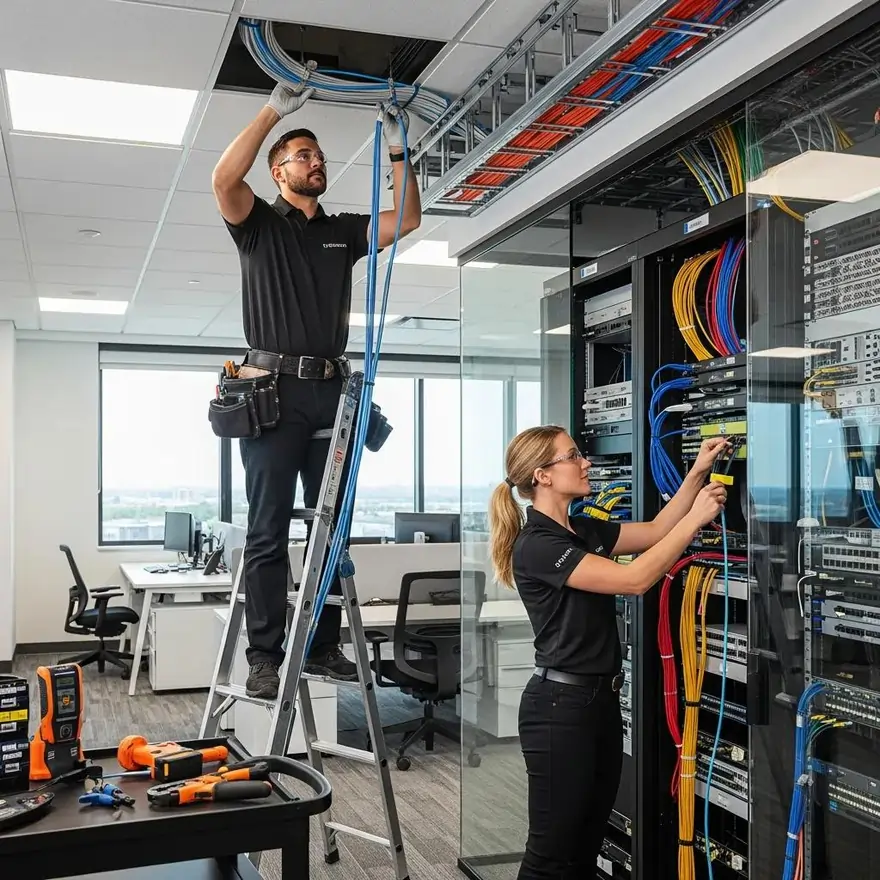
Commercial cabling provides the physical network backbone businesses depend on, when installed affordably and correctly in Sydney, it reduces downtime and boosts productivity. This article explains how affordable commercial cabling installation improves business efficiency, breaks down common service types such as commercial data cabling and fibre optic backbones, and outlines cost drivers and budgeting strategies for Sydney firms. Many businesses face intermittent connectivity, slow file transfers, and unreliable VoIP or video conferencing; correctly specified structured cabling addresses these pain points by delivering consistent bandwidth, easier maintenance, and clearer upgrade paths. You will learn why professional installers matter, how to choose between copper and fibre, what typically determines commercial data cabling cost, and the practical installation steps from consultation to testing. The guide also reviews current trends like multi-gig Ethernet and IoT integration, and shows how a local Sydney provider can implement comms cabinet solutions and documentation practices for scalable, efficient networks.
Why Choose Professional Commercial Cabling for Your Business?
Professional commercial cabling delivers a reliable, standards-compliant network infrastructure that reduces downtime, improves performance and simplifies future upgrades. Skilled installers use structured cabling principles and certified components to lower packet loss, manage electromagnetic interference and ensure predictable latency for business-critical applications. Proper installation also addresses safety and compliance with applicable wiring and telecommunications standards, which reduces long-term liability and unexpected rework. Choosing professionals saves money over time through reduced troubleshooting, faster moves/adds/changes, and documented testing that supports warranty and maintenance workflows.
The direct benefits of professional cabling are easy to summarise and useful when evaluating providers. The following list highlights the core outcomes you should expect from a professional installation:
- Improved Reliability: Certified cabling and correct terminations reduce faults and network outages.
- Predictable Performance: Structured layouts and tested channels maintain consistent bandwidth for cloud apps and VoIP.
- Scalability: Modular cabling design makes future upgrades faster and less disruptive.
- Compliance and Safety: Adherence to standards reduces risk and eases handover documentation.
These primary advantages translate into measurable operational improvements, such as fewer helpdesk tickets and faster backup/restore cycles, which lead naturally into discussing how cabling affects network performance in practice.
Genconnect Technologies is a Sydney-based provider of IT, AV, telecommunications and cabling services focusing on commercial data cabling, comms cabinet solutions and electrical cabling to improve network efficiency, scalability and future-proofing for businesses. As an example of professional practice, Genconnect emphasises structured layouts, cabinet organisation and post-install testing and documentation to support reliable operations. This example illustrates how local providers combine technical standards and practical delivery to keep projects affordable while maintaining long-term efficiency.
How Does Commercial Cabling Improve Business Network Performance?
Commercial cabling improves network performance by creating a low-error physical layer that supports consistent throughput and low latency across applications. High-quality copper or fibre links with correct shielding and separation reduce packet retransmits and collisions, which directly benefits VoIP, video conferencing and cloud service responsiveness. Properly labelled patching and well-organised comms cabinets shorten mean-time-to-repair when faults occur, reducing downtime and operational disruption. These practical impacts are visible in day-to-day metrics like lower jitter for VoIP calls and steadier transfer rates during peak business hours.
A clear example is replacing an ad-hoc cabling layout with a structured Cat6a backbone and a neat comms cabinet: the result is fewer intermittent faults and faster troubleshooting. Understanding this technical mechanism makes clear why upfront investment in professional cabling often yields superior return through ongoing operational savings and better user experience.
What Are the Key Benefits of Structured Cabling Solutions?
Structured cabling delivers organisation, predictability and reduced maintenance that together support efficient IT operations and facility changes. By grouping backbone links, work area outlets and patching in a documented topology, businesses can perform moves, adds and changes rapidly with minimal disruption. Structured approaches also improve aesthetics and asset management by centralising equipment in purpose-designed comms cabinets and labelling every circuit for quick identification. Over time, these benefits reduce on-site labour costs and prevent costly ad-hoc fixes that accumulate from unmanaged cabling.
Structured cabling also eases upgrades: a modular layout allows swapping a switch or upgrading a backbone to fibre without re-cabling every outlet. Those operational savings and reduced downtime feed directly into higher productivity and lower total cost of ownership for network infrastructure.
What Are the Main Types of Commercial Cabling Services Offered in Sydney?
Commercial cabling services in Sydney typically include copper data cabling, fibre optic backbone installation, comms cabinet design and electrical cabling for IT systems. Providers also offer testing, certification and documentation to validate performance and support warranty requirements. Each service type addresses specific use-cases: copper for short runs and workstation connectivity, fibre for backbone and long distance, cabinets for central management, and electrical cabling to ensure power and earthing integrity for active equipment. Understanding these service categories helps businesses select the right mix for capacity, budget and future growth.
The following table compares common cable types to guide choice based on bandwidth, distance and best use-case.
Different cable types suit specific network roles and help determine optimal design for office environments.
| Cable Type | Bandwidth / Capacity | Typical Max Distance | Best Use-Case |
| Cat6 (Shielded/UTP) | Up to 1 Gbps practical, supports 2.5/5G short runs | ~100 m for standard ethernet | Workstation drops in offices and meeting rooms |
| Cat6a | Up to 10 Gbps | ~100 m | High-density office floor or short server-room links |
| Cat8 | Multi-gig (25/40 Gbps) on short runs | ~30 m | Data centre top-of-rack and switch interconnects |
| Single-mode Fibre | 10 Gbps → 100+ Gbps over long distances | Kilometres depending on optics | Building-to-building or backbone links |
| Multi-mode Fibre | 10–100 Gbps over moderate distances | Hundreds of metres | Intra-building backbones and risers |
This comparison clarifies trade-offs: choose copper for cost-effective workstation connectivity and fibre where distance, capacity or EMI immunity are critical. Next we will explore data cabling specifics and when fibre becomes the right investment.
What Is Data Cabling and How Does It Support Office Ethernet Services?
Data cabling refers to the structured copper and fibre cables that connect workstations, access points and servers into a coherent network fabric. Copper categories like Cat6 and Cat6a form the common medium for office Ethernet, delivering 1–10 Gbps across standard distances with affordable components and simple terminations. Properly specified data cabling supports power-over-Ethernet for devices such as IP phones and access points, and ensures reliable performance for cloud applications and local file servers. Installation best-practices include separating power and data runs, using proper cable trays and labelling all outlets for maintainability.
Firm decisions about cable category should consider current application needs and projected growth, since a modest extra investment in Cat6a or multimode fibre today can delay costly rework later.
When Should Businesses Choose Fibre Optic Installation for Commercial Networks?
Fibre optic installation is recommended when backbone capacity, long distance runs or immunity to electromagnetic interference (EMI) are priorities. Scenarios include multi-floor buildings, campus networks, inter-building links or environments with heavy electrical noise where copper performance degrades. Fibre also yields clear future-proofing for data-heavy services like high-definition AV, large backups and edge computing, because optical capacity scales with transceiver upgrades rather than cable replacement. The trade-offs are higher initial component and termination costs plus specialised testing requirements.
Decisions should weigh current bandwidth needs, projected growth and the total lifecycle cost: when long-term capacity requirements are high, fibre typically provides a lower cost-per-gigabit over time.
How Is Commercial Data Cabling Cost Determined for Sydney Businesses?
Commercial data cabling cost is determined by labour, materials, testing and site complexity, combined with project scope such as number of drops and backbone requirements. Labour reflects access difficulty, wall penetrations and ceiling work; materials include cable category, patch panels, faceplates and comms cabinets; testing covers certification of each channel; and project management includes design and documentation. These cost drivers interact: a higher-spec cable like Cat6a raises materials cost but can reduce future upgrade expenses. Understanding these drivers enables realistic budgeting and clearer comparisons between quotes.
Below is a breakdown of typical cost drivers to help estimate where the budget is allocated before engaging an installer.
| Cost Component | Typical Range / Unit | Notes |
| Labour | Hourly or per-drop depending on access | Varies with ceiling or partition complexity |
| Materials | Per drop (cable, outlet, faceplate) | Higher for Cat6a/Cat8 and fibre components |
| Comms Cabinet & Racking | Per cabinet or rack unit | Includes rails, patch panels and cable management |
| Testing & Certification | Per channel certified | Essential for warranty and performance guarantees |
| Project Management & Documentation | Fixed or percentage of project | Includes design drawings and labelling |
This table shows that labour and testing often drive the majority of installation cost, especially in retrofit projects where access is restricted. Clear quotes that itemise these components help you compare like-for-like offers from different providers.
What Factors Influence Business Network Cabling Costs?
Several specific factors push cabling costs up or down: building access (open-plan vs partitioned), ceiling type, wall finishes, number of floors, required cable category and whether new conduits or cable trays are needed. Retrofit projects in older buildings often require more labour for chasing walls or arranging alternate pathways, while greenfield installs in new builds are typically cheaper per drop. Other influencers include required certification standards, redundancy needs for backbones and whether power or AV integration is part of the scope. These variables should be discussed during a site survey to produce an accurate quote.
How Can Transparent Pricing Benefit Your Commercial Cabling Investment?
Transparent pricing benefits buyers by making budgets predictable, exposing where savings are possible and revealing potential hidden costs such as wall restorations or specialised testing. A transparent quote itemises labour, materials, testing and documentation so you can evaluate alternatives, like choosing Cat6a versus multimode fibre for a particular run, based on clear trade-offs. Ask providers for a line-item quote, explanation of assumptions and a description of testing procedures included. Red flags include vague “per point” pricing without detail or missing certification commitments.
Clear pricing enables more effective ROI calculations and reduces surprises during installation, helping businesses make informed decisions that preserve network performance and value.
How Does Genconnect Technologies Deliver Affordable and Efficient Cabling Solutions?
Genconnect Technologies is described as a Sydney-based provider of IT, AV, telecommunications and cabling services with a focus on commercial data cabling, comms cabinet solutions and electrical cabling to improve network efficiency and scalability. The company’s approach, as represented in available descriptions, emphasises integrated systems delivery that pairs structured cabling with cabinet organisation and testing to produce reliable, maintainable networks. For businesses seeking an affordable partner, the local presence enables practical site surveys, faster response times for project coordination and alignment with Sydney building practices and compliance needs.
Genconnect’s service model includes design, installation and post-install testing and documentation as part of the handover process. This bundled approach helps businesses compare quotes on an apples-to-apples basis because it clarifies deliverables like certification reports and cabinet labelling. Contact options and next steps are typically provided by local providers so businesses can request an on-site survey and formal quotation.
What Makes Genconnect’s Structured Cabling Solutions Stand Out in Australia?
Genconnect’s profile highlights practical strengths relevant to Sydney businesses: an integrated offering that spans data cabling, comms cabinet solutions and electrical cabling, plus a local presence that supports coordination across trades. This combination supports efficient installations where cabling and electrical requirements intersect, minimising delays and ensuring consistent earthing and power provisioning for network equipment. Their stated emphasis on post-install testing and documentation aligns with best-practice requirements for reliable operations and warranty support.
These local capabilities illustrate how a single-vendor approach can reduce coordination overhead and help keep projects on schedule while maintaining compliance with relevant installation standards.
How Does Genconnect Ensure Future-Proof and Scalable Network Installations?
Genconnect’s described practices include specifying cable categories appropriate to projected growth, planning comms cabinet space for additional rack units and labelling documentation that simplifies future upgrades. These elements embody future-proofing: reserve capacity in cabinets, use of higher-spec backbone cabling where growth is anticipated, and clear channel certification that supports later equipment swaps. Delivering test results and handover documentation also reduces risk during maintenance and upgrades by giving IT teams accurate wiring maps.
By combining these design choices with local project coordination, the approach helps businesses scale network capacity with minimal disruption and predictable costs.
What Are the Latest Trends in Commercial Cabling That Boost Business Efficiency?
Recent trends in commercial cabling focus on higher-capacity copper standards, broader adoption of fibre backbones, and tighter integration with smart building systems and IoT devices. Multi-gig Ethernet over Cat6a and Cat8 supports increasing endpoint speeds without immediately moving to fibre for every run, while fibre optics continue to dominate backbone and inter-building links where distance or capacity demands are high. Convergence of AV, security and data traffic onto managed networks increases the need for disciplined structured cabling and comms cabinet planning. Sustainability considerations, such as cable material selection and efficient routing, are also emerging priorities for corporate procurement.
These market shifts mean that planners should consider both near-term requirements and flexibility for new applications when specifying cabling and cabinet resources.
The following list outlines three trends with clear implications for cabling design and business outcomes:
- Multi-gig Ethernet Adoption: Supports faster desktop and wireless uplink speeds without wholesale fibre replacement.
- Converged Networks for IoT and AV: Requires careful segmentation and power provisioning through structured cabling.
- Fibre Backbone Expansion: Future-proofs capacity for data-heavy applications and campus links.
How Does Structured Cabling Support Smart Buildings and IoT Integration?
Structured cabling provides the consistent, documented physical layer that allows sensors, access control, AV and building management systems to converge onto managed networks. A well-designed cabling plant supports Power-over-Ethernet delivery, simplifies VLAN segmentation for device classes and enables centralised routing through comms cabinets and patch panels. This unified approach reduces wiring duplication, simplifies troubleshooting of distributed IoT endpoints and supports analytics by ensuring reliable telemetry transport. For building managers, these properties translate to lower maintenance overhead and faster commissioning of new IoT devices.
Consequently, structured cabling is a foundational enabling technology for smart building initiatives that deliver operational efficiencies and improved occupant experiences.
What Role Does Fibre Optic Technology Play in Future-Proofing Networks?
Fibre optic technology is the backbone for high-capacity, long-distance and EMI-immune links that underpin scalable networks and data-centre adjacencies. Fibre’s capacity grows with transceiver technology, allowing organisations to increase throughput by upgrading electronics rather than re-cabling. This makes fibre especially useful for inter-building connections, main distribution frames and any scenario where anticipated bandwidth growth is steep. Fibre also supports resilient topologies and easy segmentation for large deployments, providing a low-latency, high-throughput foundation for future services like edge computing and high-resolution AV streaming.
When long-term capacity is required, investing in fibre backbone infrastructure is often the most cost-effective way to meet unpredictable future demands.
What Is the Commercial Cabling Installation Process for Sydney Businesses?
A well-managed installation follows a repeatable workflow from consultation to ongoing support, ensuring deliverables like certification reports and labelled cabinet diagrams are produced. The typical process includes a site survey, design and specification, installation and documentation, testing and certification, then handover with ongoing maintenance options. Each phase has clear client roles, such as approving designs or providing access, and defined deliverables that reduce ambiguity and support budget control. Following an established process helps avoid common pitfalls like scope creep, hidden restoration costs or inconsistent testing standards.
The table below maps the main process phases with expected durations and client-facing deliverables to make planning straightforward.
| Phase | Typical Duration | Deliverable |
| Consultation / Site Survey | 1–3 days depending on site size | Survey report, initial scope and preliminary drawings |
| Design & Specification | Several days to 2 weeks | Detailed cable schedules and cabinet plans |
| Installation | Varies by scope (days to weeks) | Installed cabling, mounted cabinets, labelled outlets |
| Testing & Certification | Performed after installation completion | Certification reports and test logs per channel |
| Handover & Support | Ongoing | As-built documentation and maintenance options |
This phased approach clarifies expectations and reduces the risk of rework; next we outline the key steps in actionable form for snippet-style guidance.
What Are the Key Steps from Consultation to Testing?
The installation process follows five clear steps that align planning and delivery: consultation and site survey, design and specification, installation and cable management, testing and certification, then handover with documentation and support. During the site survey, installers document routes, obstacles and power provisioning needs; design translates those findings into cable schedules and cabinet allocation. Installation focuses on correct routing, separation from power, and neat cabinet layout; testing verifies each channel meets specified standards before final sign-off. Typical timelines vary, but small to medium office installs commonly proceed from survey to handover within one to three weeks depending on complexity.
This step-by-step clarity reduces surprises and ensures each phase delivers the correct artefacts to support future maintenance.
How Does Professional Installation Enhance Network Reliability and Efficiency?
Professional installation enhances reliability by enforcing standards-based terminations, correct cable handling and systematic testing that catches faults before equipment is commissioned. Certified installers reduce the incidence of intermittent faults caused by poor terminations or improper cable bend radii; they also implement comms cabinet best-practices that streamline future work. These measures lead to measurable operational benefits such as reduced troubleshooting time, fewer service interruptions and smoother performance for latency-sensitive services like VoIP and video conferencing. The cumulative effect is higher network uptime and lower operational cost, which justify the initial investment in competent installation.
By treating cabling as a managed infrastructure component rather than an afterthought, organisations can turn lower-level savings into strategic gains across IT operations and user productivity.