
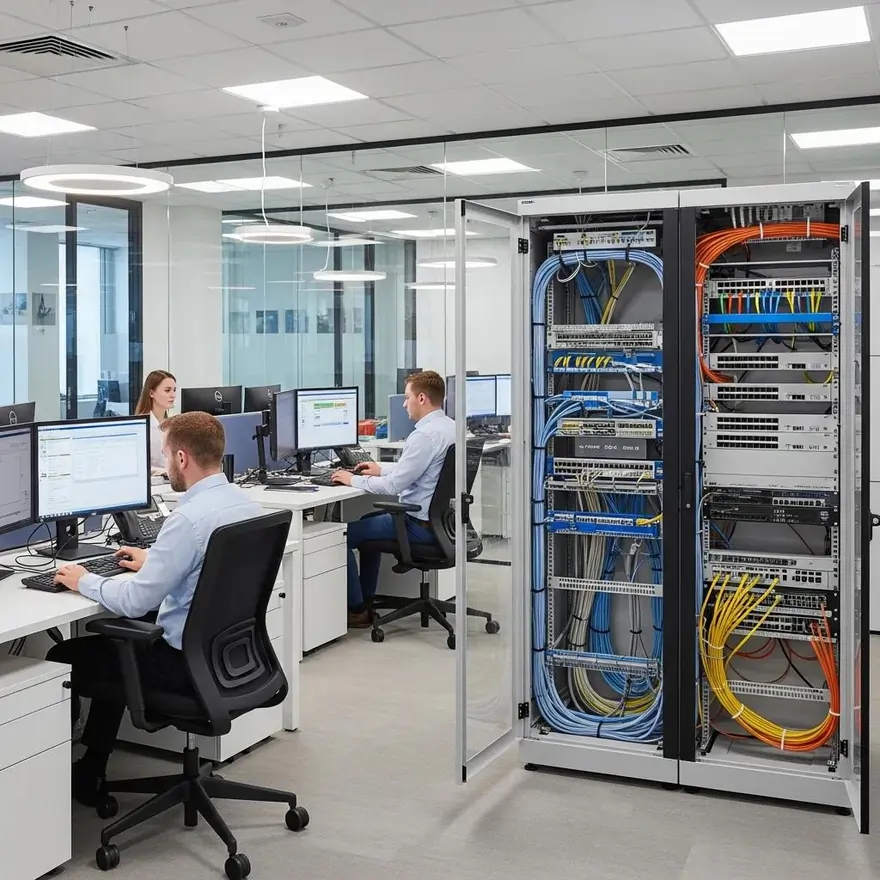
In today’s fast-paced business environment, having a reliable network infrastructure is crucial for operational efficiency. This article delves into the essential business cabling services that every office needs to ensure seamless communication and connectivity. Readers will learn about structured cabling, data cabling solutions, and the benefits of fibre optic technology, all of which are vital for modern office setups. Many businesses struggle with outdated cabling systems that hinder productivity and increase downtime. By understanding the importance of these services, companies can make informed decisions to enhance their network reliability. We will explore structured cabling services, commercial data cabling solutions, the impact of cabling on business efficiency, the advantages of fibre optic cabling, and voice and data cabling solutions.
What Are Structured Cabling Services and Why Are They Essential for Offices?
Structured cabling services refer to a comprehensive system of cabling and associated hardware that provides a complete telecommunications infrastructure. This system is essential for offices as it ensures reliable data transmission and supports various communication systems. By implementing structured cabling, businesses can enhance their network reliability, reduce downtime, and improve overall efficiency. The structured cabling system is designed to be scalable, allowing for easy upgrades and expansions as business needs evolve.
Indeed, the concept of generic cabling underpins these benefits, offering a versatile framework for modern office networks.
Modular Generic Cabling for Flexible Office Networks
Generic cabling is a highly flexible modular information transmission pipeline within or between buildings, which can not only connect voice, data, image equipment or switching equipment with other information management systems, but also connect these equipment with the outside. It also covers all cables and associated connection components between connection points of network or telecommunication lines outside the buildings and application system equipment. Generic cabling systems can accommodate components of different series and specifications, including transmission mediums, connection hardware (such as distribution frames, connectors, sockets, plugs, adapters, etc.) and electrical protection equipment, etc. Although they work together to build various subsystems, they undertake different specific tasks. Therefore, the generic cabling system is not only easy to implement, but also can be upgraded smoothly as the demand changes.
Cabling Engineering, 2022
How Does Structured Cabling Enhance Office Network Reliability?
Structured cabling enhances network reliability through its organised design, which minimises the risk of downtime. By using standardised cabling components, businesses can ensure that their network is robust and can handle increased data loads. Redundancy features, such as multiple pathways for data transmission, can further enhance reliability by providing alternative routes in case of a failure. This structured approach not only reduces the likelihood of outages but also simplifies troubleshooting and maintenance, leading to improved operational efficiency.
What Are the Key Components of a Structured Cabling System?
A structured cabling system comprises several key components that work together to create a reliable network infrastructure. These components include:
- Cables: Various types of cables, such as twisted pair and fibre optic cables, are used to transmit data.
- Connectors and Panels: These facilitate the connection between different network devices and ensure proper signal transmission.
- Installation Practices: Proper installation techniques are crucial for maintaining the integrity of the cabling system and ensuring optimal performance.
Understanding these components helps businesses appreciate the importance of investing in a well-designed structured cabling system.
Which Commercial Data Cabling Solutions Best Support Modern Office Networks?
Modern office networks require efficient data cabling solutions to support high-speed internet and seamless communication. Various types of data cabling solutions are available, each offering unique benefits tailored to different business needs. Selecting the right cabling solution is essential for optimising network performance and ensuring future scalability.
What Are the Benefits of Cat6a and Fibre Optic Cabling for Businesses?
Cat6a and fibre optic cabling are two popular choices for commercial data cabling. Cat6a cables provide high-speed data transmission up to 10 Gbps over distances up to 100 meters, making them ideal for most office environments. They are cost-effective and relatively easy to install, providing a reliable solution for businesses looking to upgrade their network infrastructure. On the other hand, fibre optic cabling offers superior speed and bandwidth capabilities, supporting data transmission over much longer distances without signal degradation. This makes fibre optic an excellent choice for businesses anticipating significant data growth in the future.
The growing reliance on Cat6a for high-demand services underscores the critical need for quality and robust cabling to ensure reliable Ethernet performance.
Ensuring Reliable Ethernet with Quality Cat 6A Cabling
This paper provides a method of assessing the toughness of augmented cables required for Ethernet technology. The use of augmented category 6 (Cat 6A) in Ethernet-enabled Internet of Things (IoT) infrastructure continues to grow due to the high demand for services requiring such configuration. The increasing demand for Cat 6A over Ethernet is due to its ability to transmit both data and power to devices used in IoT which is cost-saving. However, the availability of counterfeit and substandard cables in the market disguised as category-rated cables is of great concern to cable installers and engineers. There is also the basic problem of handling stress anticipated during installation as cables could be manipulated in the form of repeated coiling and uncoiling. Therefore, there is a need to have a method of assessing the toughness of the cables before deployment.
Toughness of augmented cables for ethernet technology assessment, O Ogundapo, 2024
How Is Professional Data Cabling Installation Conducted?
Professional data cabling installation involves several critical steps to ensure optimal performance and compliance with industry standards. The process typically begins with a thorough assessment of the office layout and network requirements. Following this, a detailed cabling plan is developed, outlining the types of cables and installation methods to be used. The installation itself includes running cables through walls and ceilings, connecting them to network devices, and conducting post-installation testing to verify performance. Engaging professional services ensures that the installation is done correctly, minimising potential issues down the line.
How Do Office Network Infrastructure Cabling Services Improve Business Efficiency?
Office network infrastructure cabling services play a vital role in enhancing business efficiency by providing a reliable foundation for communication and data transfer. A well-designed cabling system can significantly impact productivity, reduce operational costs, and improve overall workplace satisfaction. By investing in quality cabling services, businesses can ensure that their network infrastructure supports their operational goals.
What Role Do Comms Cabinet Solutions Play in Network Organisation?
Comms cabinet solutions are essential for organising and managing network equipment within an office environment. These cabinets provide a secure and structured space for housing servers, switches, and other networking devices. By utilising comms cabinets, businesses can improve space management, streamline cable organisation, and facilitate easier access for maintenance and upgrades.
This organisation not only enhances the aesthetic appeal of the office but also contributes to better airflow and cooling for critical equipment.
How Does Electrical Cabling Support Office Power and Safety Standards?
Electrical cabling is crucial for powering office equipment and ensuring compliance with safety standards. Proper electrical cabling installation helps distribute power efficiently while minimising the risk of electrical hazards. Adhering to safety regulations is essential for protecting both employees and equipment. Businesses must ensure that their electrical cabling meets local codes and standards to avoid potential liabilities and ensure a safe working environment.
Why Is Fibre Optic Cabling Increasingly Preferred for Business Networks?
Fibre optic cabling is becoming the preferred choice for business networks due to its numerous advantages over traditional copper cabling. As businesses increasingly rely on high-speed internet and data-intensive applications, fibre optic technology offers the performance and reliability needed to meet these demands.
What Are the Advantages of Fibre Optic Cabling Over Traditional Ethernet?
Fibre optic cabling provides several key advantages over traditional Ethernet cabling. Firstly, it offers significantly higher bandwidth capabilities, allowing for faster data transmission rates. Secondly, fibre optic cables are immune to electromagnetic interference, ensuring a stable connection even in environments with heavy electronic equipment. Lastly, fibre optic cabling can transmit data over much longer distances without signal loss, making it ideal for large office spaces or multi-building campuses.
How Does Fibre Optic Cabling Future-Proof Office Network Infrastructure?
Investing in fibre optic cabling is a strategic move for future-proofing office network infrastructure. As technology continues to evolve, the demand for higher data speeds and increased bandwidth will only grow. Fibre optic cabling is designed to accommodate these advancements, allowing businesses to scale their network capabilities without the need for extensive rewiring. This adaptability ensures that companies can keep pace with technological changes and maintain a competitive edge in their respective industries.
What Are Voice and Data Cabling Solutions for Offices and Their Benefits?
Voice and data cabling solutions are essential for facilitating seamless communication within a modern office environment. At Genconnect Technologies, these solutions are designed to integrate voice and data services into a single, reliable infrastructure, allowing employees to communicate efficiently while accessing critical business information. Understanding the benefits of structured cabling helps organisations optimise performance, scalability, and long-term cost efficiency.
How Do Voice and Data Cabling Integrate for Seamless Communication?
Voice and data cabling integration allows for a unified communication system that enhances collaboration among employees. By using a single cabling infrastructure for both voice and data services, businesses can reduce installation costs and simplify maintenance. This integration also enables features such as VoIP (Voice over Internet Protocol), which can significantly lower communication expenses while improving call quality.
What Are Common Installation and Maintenance Best Practices?
To ensure the longevity and performance of voice and data cabling systems, businesses should adhere to common installation and maintenance best practices. These include:
- Proper Planning: Assessing the office layout and communication needs before installation.
- Quality Materials: Using high-quality cables and connectors to ensure optimal performance.
- Regular Maintenance: Conducting routine inspections and testing to identify potential issues before they escalate.
By following these best practices, businesses can maintain a reliable communication infrastructure that supports their operational goals.