
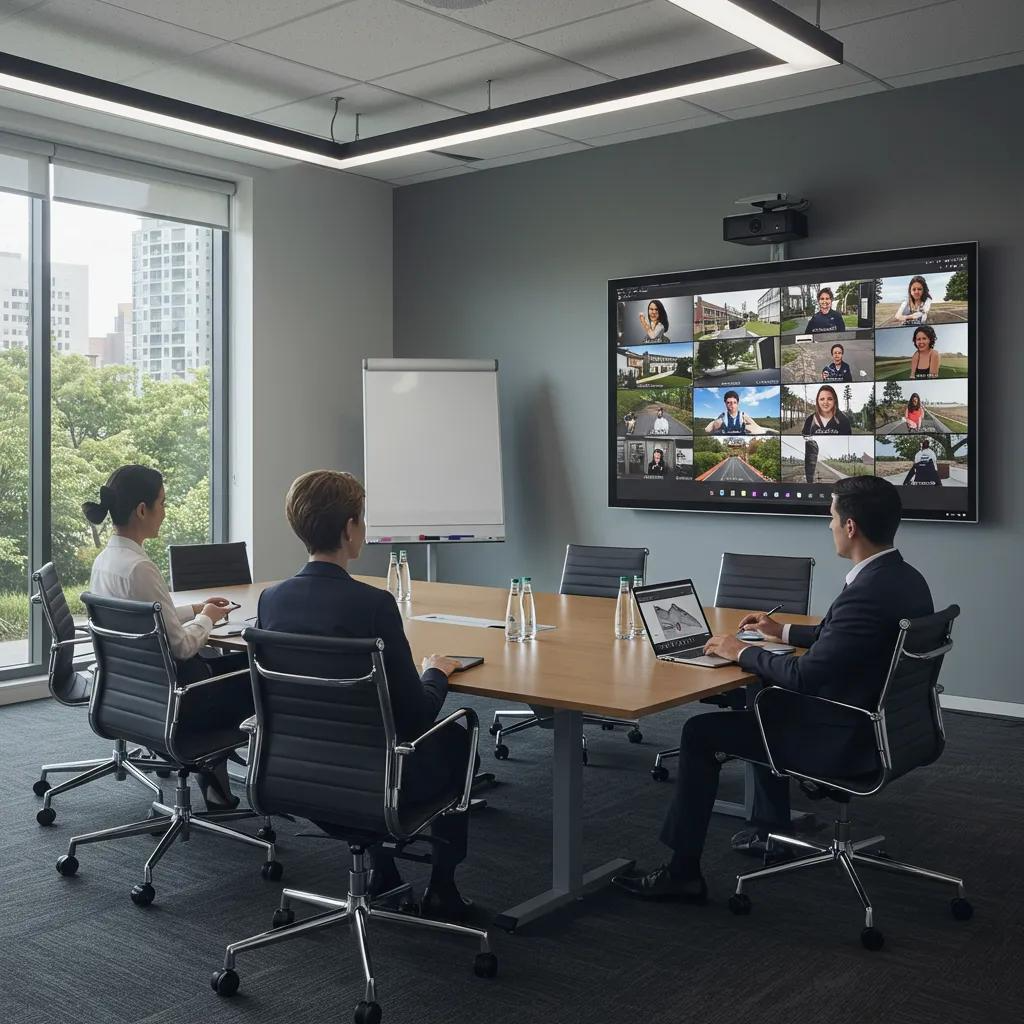
Effective conference room setup and design hinges on boardroom technology solutions that seamlessly integrate audio-visual systems, centralised control, and network infrastructure to enhance collaboration and productivity. In this guide, we explore the essential components of modern boardroom technology, demonstrate how hybrid meeting room solutions transform collaboration, and outline best practices for ergonomic and aesthetic conference room design. We then examine advanced AV technologies, secure IT infrastructure considerations, emerging AI and automation trends, industry-specific configurations, and the proven business benefits of integrated systems. Finally, we address common queries to clarify critical aspects of selecting and deploying effective boardroom technology. By mapping these themes, readers gain a clear pathway to optimising meeting efficiency and future-proofing their organisations’ collaboration spaces.
What Are the Essential Components of Modern Boardroom Technology Solutions?
A modern boardroom technology solution combines hardware, software, and services to deliver reliable collaboration and decision-making support. Defining it as a comprehensive system, the solution includes AV integration, IT infrastructure, and centralised management to eliminate technical friction during meetings. For example, a high-definition video conferencing codec links remote participants, ensuring real-time interaction and clear visuals. Through this mechanism, organisations reduce downtime and sustain engagement, showcasing why integrated systems are vital for today’s dynamic work environments.
| Component | Core Function | Business Value |
| Video Conferencing System | Captures and transmits high-quality video | Boosts remote engagement and clarity |
| Professional Audio System | Manages voice input and noise cancellation | Ensures crystal-clear communication |
| Interactive Display | Supports touch annotation and whiteboarding | Enhances visual collaboration and ideation |
| Wireless Presentation Tool | Enables cable-free content sharing | Reduces setup time and user frustration |
| Centralised Control System | Automates device scheduling and settings | Simplifies operation and standardises workflows |
Each component works together to establish a unified environment that supports seamless meetings and paves the way for hybrid collaboration enhancements.
In practice, companies like Crestron and Logitech offer integrated solutions that combine these elements into tailored packages, matching specific room sizes and usage profiles. Leveraging expertise in installation services and maintenance, these companies ensure that each element is optimally calibrated, laying a foundation for advanced hybrid meeting room solutions.
How Can Hybrid Meeting Room Solutions Transform Your Conference Room?
Hybrid meeting room solutions blend in-person dynamics with remote collaboration tools to bridge geographical divides and foster inclusive participation. These solutions integrate video conferencing systems, unified communications platforms such as Microsoft Teams or Zoom, and room booking interfaces to synchronise schedules and technical setups. Deploying unified communications platforms reduces platform switching and delivers consistent user interfaces, which improves adoption rates and meeting productivity.
Key benefits of unified communications platforms in hybrid meeting rooms include:
- 1. Enhanced participant presence tracking through occupancy sensors and calendar integration.
- 2. Seamless transition between on-site and remote attendees via single-click meeting join.
- 3. Built-in features like instant messaging, file sharing, and virtual whiteboarding to co-create in real time.
- 4. Scalable licensing models that adjust to seasonal or organisational growth without major infrastructure changes.
These advantages drive higher room utilisation and fewer scheduling conflicts, readying organisations for evolving collaboration demands. Integrating room booking systems further optimises space usage by providing live availability dashboards and automated notifications, which eliminate double-booking and enable strategic capacity planning.
Addressing the varied needs of hybrid work, companies configure room-booking applications to sync with corporate calendars and allocate resources like cameras and speakers automatically at meeting start. By linking collaboration tools with wireless presentation systems, the transition between in-person presenters and remote facilitators becomes frictionless, setting the stage for best practices in conference room design.
Audio-Visual Support for Remote Participants in Electronic Meetings
The technological framework of the developed intelligent meeting room implements a multichannel audio-visual system for participant activity detection and automatically composes actual multimedia content for remote mobile users. The developed web-based application for remote user interaction with the equipment of the intelligent meeting room and the organisation of electronic meetings was tested with Nokia mobile phones.
Multichannel system of audio-visual support of remote mobile participant at e-meeting, AL Ronzhin, 2010
What Are the Best Practices for Designing Effective Conference Rooms?
Effective conference room design draws on acoustic, lighting, ergonomic, and aesthetic principles to create productive environments and reduce technical barriers.
Acoustic treatment improves speech intelligibility by absorbing reverberations and isolating external noise, allowing participants to focus on content without distraction. For instance, wall panels and ceiling clouds target specific frequency ranges, delivering consistent audio clarity throughout the space.
When considering lighting designs, combining diffused ambient sources with directional fixtures reduces shadows on faces and enhances video conferencing quality. Adjustable color temperatures support different meeting types, from brainstorming sessions requiring warm tones to formal presentations needing cooler illumination.
Proper ergonomic furniture and seating arrangements ensure comfort during extended meetings, contributing to sustained engagement and reducing fatigue.
Prioritising cable management preserves both aesthetics and functionality. Concealed raceways and under-table channels keep power and data lines organised, minimising trip hazards and simplifying maintenance. By coordinating furniture placement with AV equipment, designers can maintain clean sightlines, optimise speaker and microphone placement, and uphold a professional atmosphere.
Implementing these best practices results in conference rooms that support high-quality interactions and create environments conducive to effective collaboration, which naturally leads to exploring cutting-edge AV technologies that drive engagement.
Audio-Visual Fusion for Smart Meeting Room Context Analysis
This paper proposes a novel online context analysis framework to support context-aware computing in smart meeting rooms. A novel dynamic context model is presented for modelling human group interactions. Robust audio and visual modules are integrated for the effective processing of multimodal signals from various sensors. Based on these, a multi-level dynamic context reasoning mechanism is employed for the online understanding of group interactions in meeting scenarios. Experimental results demonstrate the effectiveness of our framework.
Audio-visual fused online context analysis toward smart meeting room, 2007
Which Modern Conference Room AV Technologies Drive Engagement and Efficiency?
Modern conference room AV technologies combine high-definition displays, interactive surfaces, and professional audio to elevate meeting dynamics. Interactive displays and LED walls invite participants to engage through touch annotation, digital whiteboarding, and content co-creation, promoting active collaboration. With features like multi-touch recognition and built-in Android or Windows platforms, these displays function as standalone meeting hubs.
Professional audio systems feature beam-forming microphones, noise-cancellation algorithms, and ceiling or tabletop speakers tuned for speech frequencies. These systems ensure every participant, local or remote, hears and is heard with equal clarity. High-definition projectors and screens deliver vivid visuals for large-format presentations, supporting resolutions up to 4K and HDR content for detailed technical diagrams or marketing assets.
| Technology | Standout Feature | Result |
| Interactive Touch Panel | Multi-touch annotation | Encourages group ideation |
| LED Video Wall | Seamless bezel-free modules | Creates immersive presentation backdrops |
| Beam-forming Microphone | Directional voice capture | Isolates speaker voice from ambient noise |
| 4K Laser Projector | High lumen output | Maintains image brightness in ambient light |
These AV technologies converge to lower meeting friction, sustain engagement, and empower teams to communicate visual and verbal information seamlessly. With a robust AV backbone in place, IT infrastructure considerations become crucial to support and secure these systems effectively.
How Does IT Infrastructure Support Secure and Scalable Boardroom Technology?
Secure network integration and scalable IT infrastructure underpin the reliability of boardroom technology solutions. Best practices include segmenting AV devices on dedicated VLANs, enforcing encryption protocols, and implementing network access control to restrict unauthorised equipment connections. By isolating meeting room gear from general office traffic, IT teams reduce security risks and maintain predictable bandwidth for video and audio streams.
Cloud-based AV management systems simplify maintenance by centralising firmware updates, system monitoring, and performance analytics in a single portal. Administrators receive alerts on device health, enabling predictive maintenance that prevents downtime. This approach aligns with rising demand for managed AV services, as reflected in the trend towards cloud-centric workplace management.
Addressing cybersecurity is essential for protecting sensitive meeting data, especially during board-level discussions. End-to-end encryption for video calls, secure credential management, and regular vulnerability assessments ensure confidentiality. These measures foster trust among stakeholders and comply with data privacy regulations, reinforcing the organisation’s risk management framework.
Secured and scalable IT infrastructure thus amplifies the value of advanced AV deployments, ensuring that technology investments deliver consistent performance and long-term adaptability, factors that seamlessly transition into AI-powered automation strategies.
How Are AI and Automation Shaping the Future of Boardroom Technology?
AI-powered meeting tools and automation technologies are redefining boardroom experiences by delivering real-time insights and reducing manual intervention. AI assistants transcribe discussions, extract action items, and generate searchable meeting summaries, saving administrative time and ensuring no critical decisions are overlooked. Predictive maintenance leverages analytics to forecast component failures, such as projector lamp end-of-life or microphone signal degradation, prompting service calls before disruptions occur.
Touchless room automation introduces occupancy-based lighting, HVAC adjustments, and contactless controls (gesture or voice-activated) to enhance hygiene and user convenience. Machine vision systems monitor room utilisation and adjust setups dynamically, optimising resource allocation and energy consumption without manual input. As organisations strive for sustainability and efficiency, these smart room features deliver measurable reductions in operational costs and environmental impact.
By embedding AI in boardroom technology, businesses achieve proactive maintenance, contextual meeting support, and adaptive environments that respond to user behavior. Companies collaborate with leading AI platform providers to integrate these innovations, future-proofing meeting spaces and setting a new standard for productivity and user satisfaction.
What Are the Industry-Specific Solutions for Boardroom Technology?
Different sectors face unique challenges in conference room design, and industry-specific solutions address compliance, user profiles, and security requirements. In finance and legal settings, secure boardroom technology includes encrypted video streams, biometric access control, and detailed audit trails to satisfy regulatory standards and protect confidential deliberations. These measures uphold data integrity and foster stakeholder trust.
Educational institutions require flexible configurations that support lecture capture, remote guest lectures, and student collaboration. Interactive displays with multi-user annotation, integrated document cameras, and campus-wide scheduling systems ensure seamless integration with learning management platforms. Scalability and ease of use are paramount for simple turnover between classes and events.
IT and telecom businesses leverage advanced collaboration tools, such as multi-site video conferences and developer-friendly API integration, to prototype and test communication solutions. By deploying modular AV racks and software-defined room controllers, these enterprises can pilot innovations and iterate quickly on feature sets while maintaining enterprise security standards.
Tailoring boardroom technology to specific industries ensures that each space delivers both functional excellence and compliance with sector norms, reinforcing the value proposition of integrated solutions and paving the way to quantify their benefits.
What Are the Proven Benefits of Integrated Boardroom Technology Solutions?
Integrated boardroom technology solutions improve collaboration, drive productivity, and unlock cost savings for businesses of all sizes. By combining AV, IT, and automation components into a cohesive ecosystem, organisations reduce setup complexity and technical downtime, resulting in smoother meeting experiences. Collaboration is enhanced through unified interfaces and streamlined workflows, enabling teams to focus on content rather than operations.
Cost savings emerge from reduced travel expenses, as hybrid meetings replace many face-to-face engagements. Energy-efficient devices and intelligent scheduling further shrink overheads by powering down equipment when rooms are idle. A holistic view of performance metrics, from utilisation rates to maintenance costs, allows for data-driven decisions that optimise resource allocation and justify return-on-investment.
Case studies demonstrate real-world success: clients report up to a 30 percent increase in meeting efficiency and a 20 percent reduction in AV-related technical support calls post-deployment. These figures underscore the tangible outcomes of integrated solutions and illustrate how strategic technology investments deliver measurable business value.
What Are the Frequently Asked Questions About Boardroom Technology Solutions?
Boardroom technology often prompts questions regarding its composition, design, and benefits. Below are clarifications on four core topics that commonly arise during planning and implementation.
What Technology Is Used in a Modern Boardroom?
Modern boardrooms utilise a combination of high-definition video conferencing codecs, beam-forming microphones, multi-touch interactive displays, wireless content sharing devices, and centralised control panels. Each element works in concert to deliver clear audiovisual communication, spontaneous collaboration, and simplified management, ensuring meetings run efficiently.
By selecting components from reputable brands and validating compatibility, businesses minimise integration issues and sustain a high-availability meeting environment.
How Do You Design an Effective Conference Room?
Designing an effective conference room requires attention to room geometry, acoustic treatment, lighting balance, ergonomic seating, and equipment placement. Proper acoustic panels reduce echo, adjustable lighting supports video clarity, and furniture layouts maintain sightlines to the display. Integrating cabling beneath floors or within walls preserves aesthetics and prevents trip hazards.
A holistic approach to spatial design enhances user comfort and reinforces the technological capabilities that drive productive meetings.
What Are Hybrid Meeting Room Solutions?
Hybrid meeting room solutions combine local AV setups with cloud-based unified communications platforms, enabling on-site attendees and remote participants to engage in the same session seamlessly. Key features include synchronised scheduling, single-click join, collaborative whiteboarding, and real-time transcription. These solutions bridge physical and digital environments, fostering inclusive interactions and reducing travel overhead.
Organisations adopting hybrid solutions observe increased participation and a broader talent pool for collaborative projects.
How Can Technology Improve Boardroom Collaboration?
Technology improves boardroom collaboration by automating routine tasks, facilitating real-time content sharing, and delivering immersive communication tools. Features like instant file distribution, interactive whiteboards, and AI-driven meeting summarisation ensure participants stay aligned and decisions are documented. Centralised control systems reduce setup time, allowing meetings to commence promptly and maintain momentum.
When technology supports natural interaction rather than obstructing it, teams can leverage collective expertise more effectively and achieve faster outcomes.
Implementing boardroom technology solutions with expert design, installation, and ongoing support equips organisations to drive collaboration and productivity in every conference room.
In summary, a strategic approach to boardroom technology solutions, grounded in essential components, hybrid capabilities, best-practice design, advanced AV, secure IT infrastructure, AI automation, and industry-tailored configurations, delivers measurable benefits in collaboration, efficiency, and cost savings. By partnering with specialists who understand these elements holistically, businesses can future-proof their meeting spaces and empower teams to make better decisions, faster.
For more information, visit our website Genconnect Technologies.